
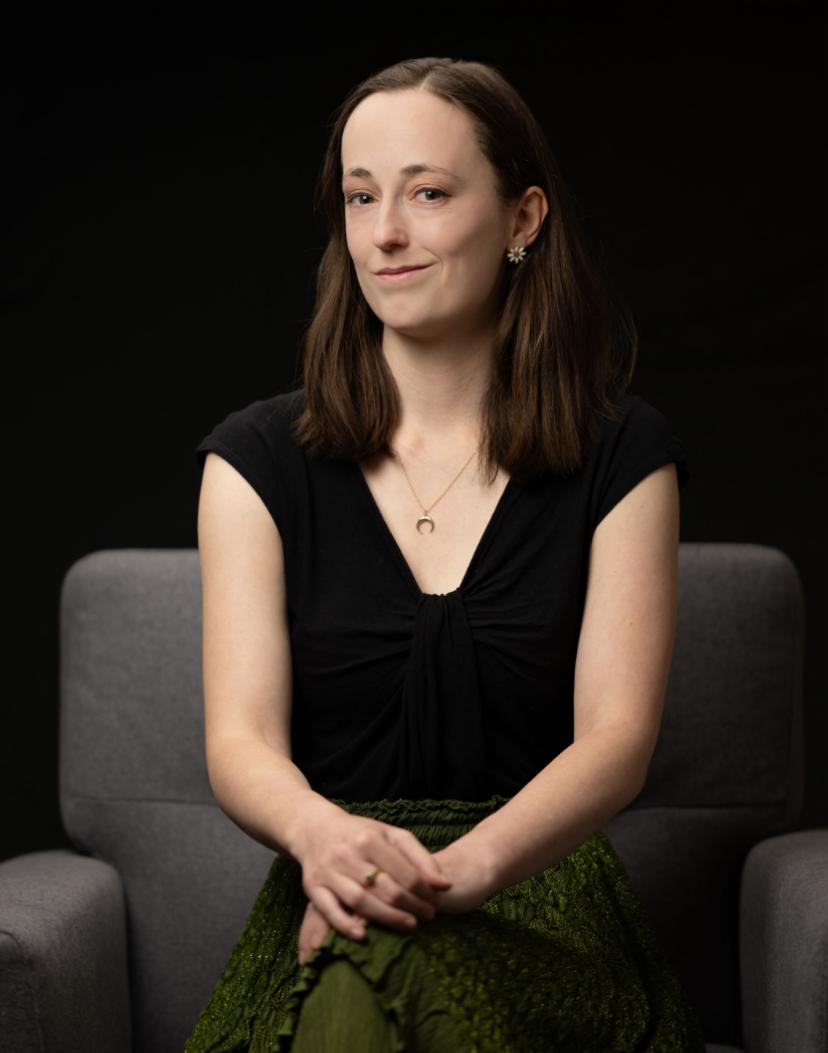
This is the first in a series of posts highlighting members of our London Playwrights community.
Sierra is a Canadian writer who took part in WrAP for the first time this year. I spoke to her over the phone in January about her work and what interests her as a writer.
Sierra began writing at 13 when she got her first computer. She started with novels but found herself losing the joy of writing after a while and became stuck on her draft. On a trip to London for her 30th birthday, she saw the true diversity and possibility of theatre for the first time (particularly, the straight play). “[I realized] maybe it’s not a novel, it’s a play,” she tells me. Four months later, she had a first draft of a new play.
Sierra’s work is interested in exploring the soft and positive sides of platonic female relationships. In the theatre, she loves moments of stillness and the potential they hold. For WrAP, she was working on a play about what ties a family together, and the experience of growing up away from an aspect of your family and culture. Two half-sisters, one raised in Wales and the other in Canada, reunite when the younger makes a trip to Wales after graduating high school. In this week, she plans to reconnect with the other half of her family, but when her father shows up to her sister’s flat, she realizes that the process will not be as easy as she thought. The novel version, she tells me, originally centred a French-Canadian family, but having been learning Welsh since 2018, she decided to make this change when she began writing the play.
One concern she shared with me was how to write the play in a manner respectful to Welsh culture and communities, as someone not Welsh herself. Sierra’s background is Scottish, but when she wanted to learn a Celtic language in 2018, she couldn’t find resources to learn Scottish Gaelic, and so, learnt Welsh instead. She’ll be making another trip to Wales later this year, and speaking with people with connections to Wales (like London Playwrights’ own Emily Garside).
When I asked her what she loved most about the process of writing this play, she told me it was that while doing it she felt fully that she was writing it purely for herself. No part of her brain thought about what anyone else might think, she’d left that all for the redraft.
Once she’d gotten the first draft down, she turned to the internet for resources to develop her craft (Sierra lives in the Yukon, in a town of only about 450 people). Some of these included online courses through the University of Toronto, and Kimberley’s podcast Playwriting Real-life, an episode of which led her to WrAP.
When I asked her (in mid-January) how she was finding WrAP, Sierra shared that at times she found it hard to catch up and was falling behind because of volunteering and work commitments. This is how I found out she was a volunteer firefighter and had in fact been out on a fire call the day before. The most interesting thing about our chat, to me, was finding out how her life experiences had changed her as a writer, including motivating a shift in form.
As I was writing this (in March!), I checked in with Sierra to get an update on her progress since WrAP ended:
“Welp! I finished a second draft and I started a second level playwriting course online this month. I have gotten some really positive feedback from the instructor about the completeness of the play and the natural dialogue between the sisters. Shoutout to Emily for helping me with my Welsh questions!”
Many thanks to Sierra for her time, and thank you for reading! For more ways to engage with London Playwrights, consider signing up as a Member here!